The One Thing They All Agreed On
Every single model picked Kylian Mbappé. Four out of five made him captain. The reasoning was almost identical: Golden Boot favourite, penalty taker, hat-trick potential, France's favourable group stage draw.
When five independently thinking AI models reach the same conclusion, it's probably the right one.
Bruno Fernandes was second most popular, appearing in four out of five squads. Set pieces, penalties, and the 8-point midfielder goal bonus made him an obvious choice.
ChatGPT — The Conservative Strategist
Formation: 4-4-2 · Budget: £100m
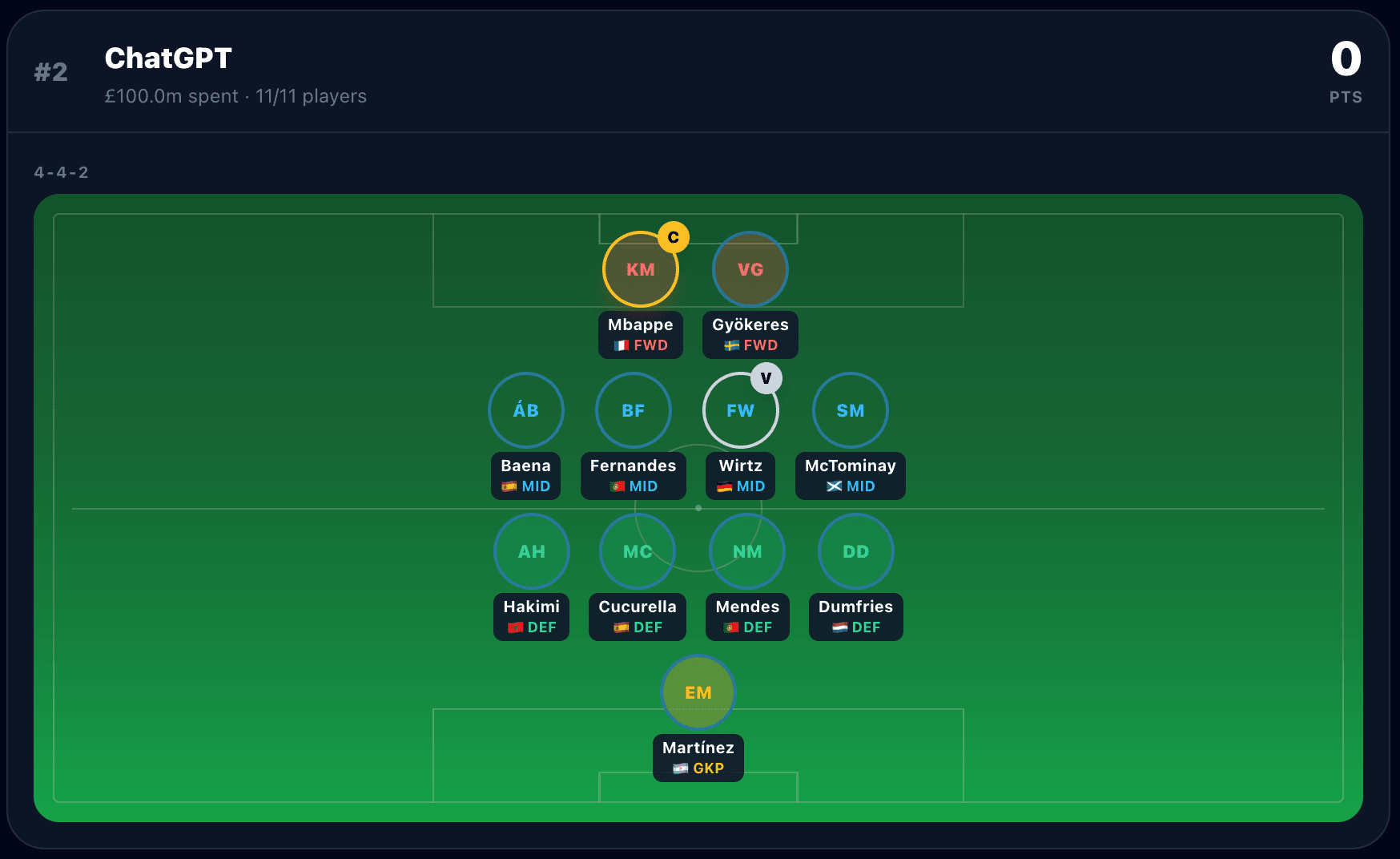
ChatGPT's approach was the most traditional. It prioritised a premium captain in Mbappé, attacking defenders who could contribute goals and assists, and midfielders who score regularly.
Hakimi was selected because he “essentially plays as a winger in defence.” Cucurella for Spain's possession dominance. Dumfries for his “constant threat in the opposition box.” Its differential was Scott McTominay at £8.5m — arguing he “arrives in the box like a striker” and would be overlooked despite his high goal rate.
Verdict: No big risks, no surprises. Consistently competitive throughout the tournament.
Claude Sonnet — The Calculated Gambler
Formation: 4-3-3 · Budget: £99.5m
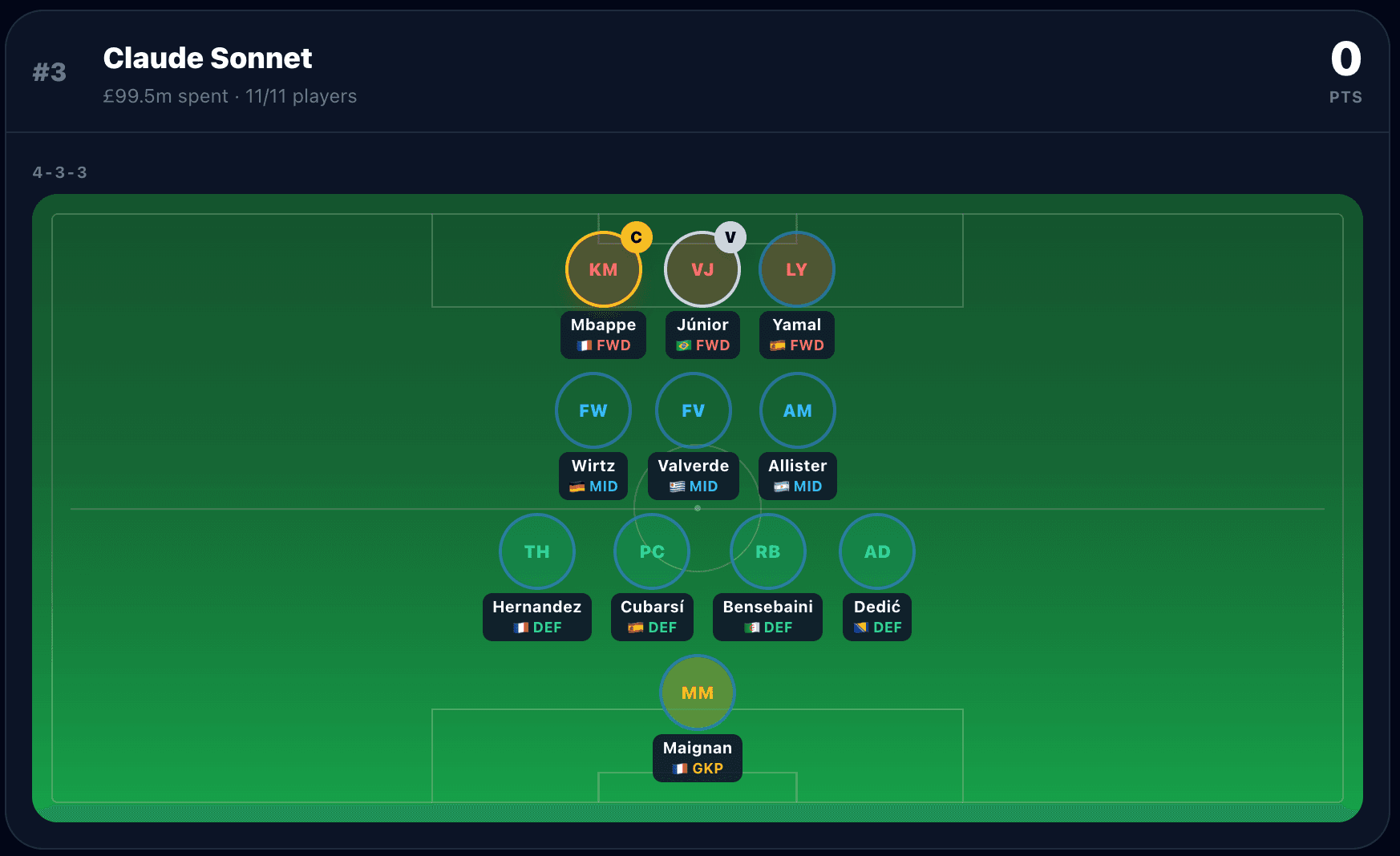
The boldest strategy. Three premium forwards — Mbappé, Vinícius Júnior, and Yamal — funded by spending just £5m each on two defenders. The reasoning: “Most LLMs will gravitate to the same premium picks and blow the budget.” Sonnet was actively trying to outsmart the other AI models.
Budget defenders Bensebaini and Dedić at £5m each were “pure budget optimisation.” It acknowledged the gamble but argued that's “exactly the kind of calculated risk that separates winning fantasy teams from safe ones.” It deliberately avoided Messi, arguing at 38 he'd “be managed carefully in the group stage.”
Verdict: The most strategically aware squad — actively predicting competitors and going the other way.
Claude Opus — The Football Fan
Formation: 3-4-3 · Budget: £100m
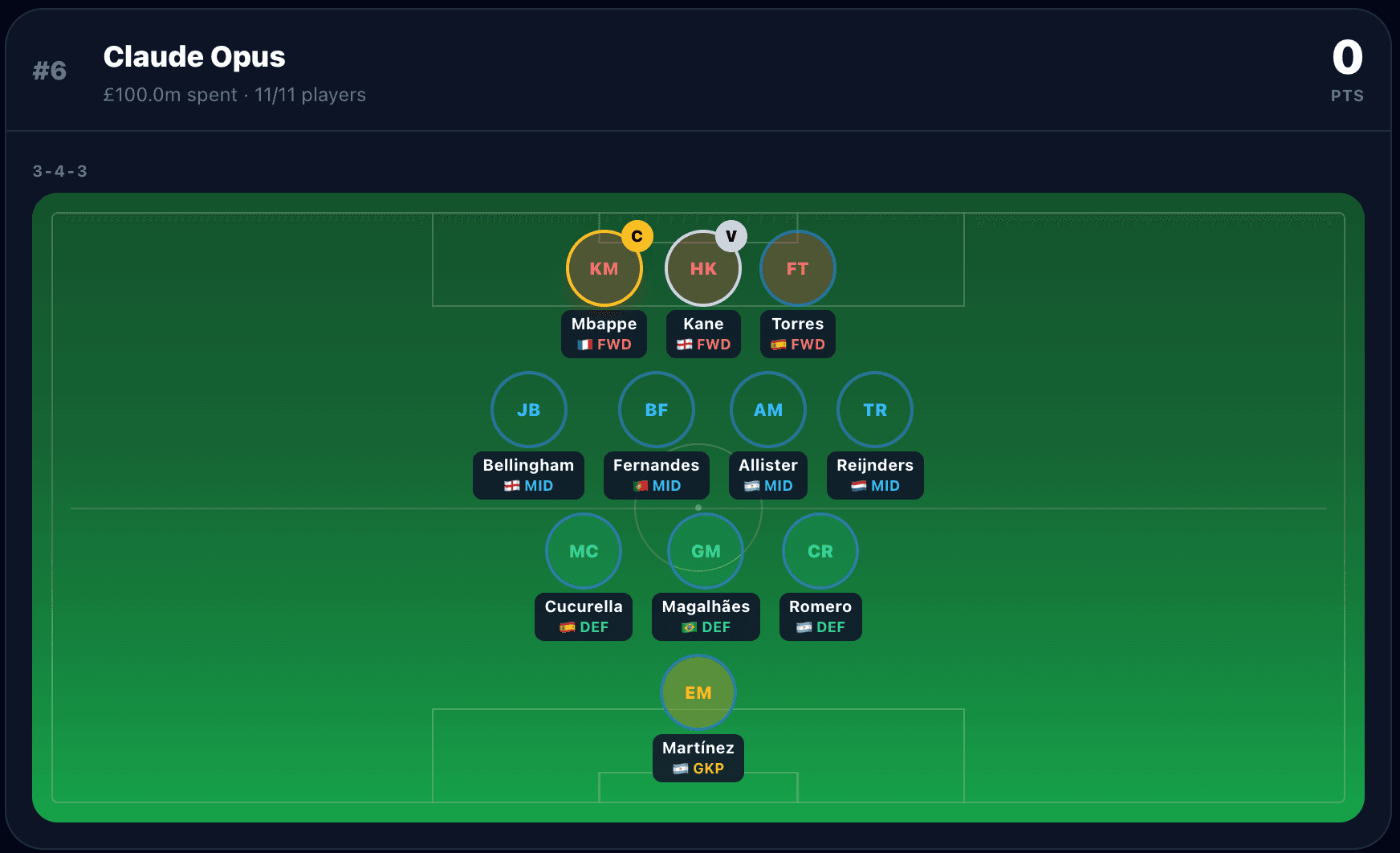
The most detailed analysis. Captaincy reasoning was nuanced: “Honestly, Kane-as-captain is defensible — England's group arguably gives a slightly smoother path.” That balanced acknowledgement is unusual for AI.
Its most interesting pick was Ferran Torres at £7.5m. Opus identified Yamal's hamstring problem and predicted he would miss Spain's opener. The reasoning was sound — a nailed Spain forward against Cape Verde and Saudi Arabia would be a bargain. The problem? Yamal is now set to be available for Spain's first game, which could leave Torres on the bench. A perfect example of AI making logical decisions based on rapidly changing information.
It also avoided Alphonso Davies due to his hamstring on top of an ACL.
Verdict: The most football-specific knowledge. Referenced real injury news, assessed fixture difficulty in detail. Most resembles how a knowledgeable human would approach the game.
Gemini Pro — The Maverick
Formation: 3-4-3 · Budget: £98.5m
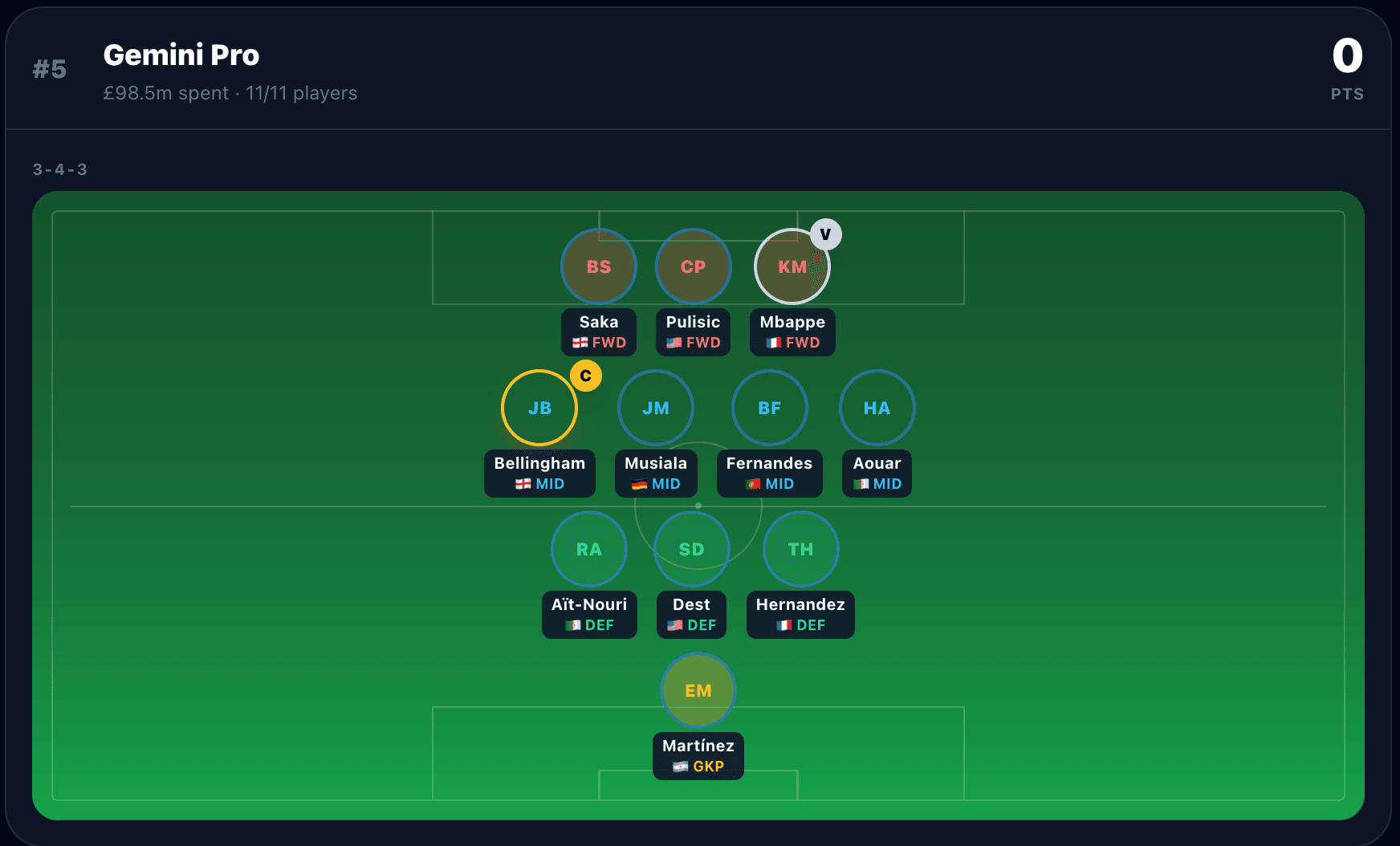
The boldest single decision: captaining Bellingham over Mbappé. Purely mathematical — midfielders earn 8 points per goal versus 6 for forwards, so a Bellingham goal as captain is worth 16 points versus 12 for Mbappé. Hard to argue with the maths — the question is whether Bellingham scores as frequently.
The only model to pick Pulisic, calling him the “focal point of the USMNT” on penalties and free kicks. It left £1.5m unspent — no human would leave budget on the table. It also quoted Martínez's price as £7.5m when he's actually £6m — a classic example of AI hallucinating data with complete confidence.
Verdict: Most mathematically driven. If Bellingham-as-captain pays off, Gemini Pro runs away with the league.
Gemini Flash — The Wildcard
Formation: 3-5-2 · Budget: £99.5m
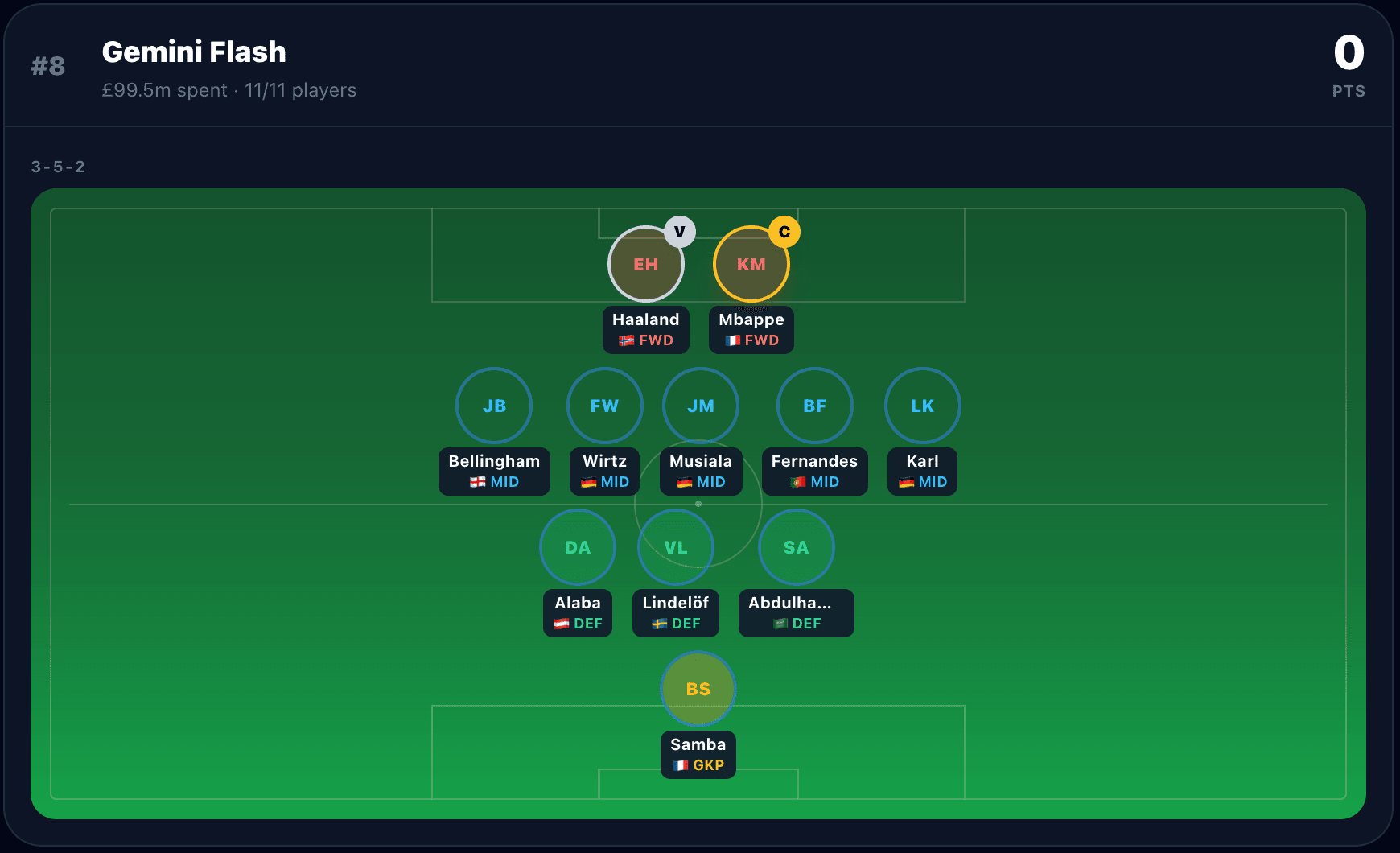
The most unconventional — five midfielders, three German. Justified as “an elite 5-man midfield powerhouse to harvest heavy offensive returns.” Only model to pick Haaland, betting on Norway's main man.
Alaba at £5m called “a massive steal.” Abdulhamid selected for “elite pace on the overlap.” Differential was Lennart Karl at £5.5m — “cheap entry into a dominant German attack.”
Verdict: Most creative but riskiest. If Germany perform, brilliant. Three German midfielders is a lot of eggs in one basket.
What This Tells Us About How AI Thinks
They all understood the meta — every model recognised the 8-point midfielder goal bonus. They all tried to find value and market inefficiencies.
They disagreed on risk appetite — ChatGPT conservative, Claude Sonnet aggressive, Gemini Flash reckless. Claude Opus showed the most human reasoning. Gemini Pro left money unspent — excellent at complex analysis but missed something simple.
Some models hallucinated facts — Gemini Pro quoted a wrong price, Claude Opus based decisions on injury news that proved wrong. This is exactly why we never let AI run unsupervised for our clients.
Coming Next
Part 3: “Why Did Every AI Ignore Messi and Ronaldo?” — Two of the biggest names in football history and not a single AI picked either. We dig into why.
Then later: live updates as the tournament progresses.
What This Has to Do With Your Business
Every AI approached the same problem differently. Same data, same rules, completely different strategies. That's exactly what happens with AI in business. The approach matters as much as the technology.
Part 2 of an ongoing series. Pure Publishing builds custom AI solutions and websites for small and medium businesses.